Despite the relatively small distance between El Calafate in Argentina and Torres del Paine in Chile, our next destination, the journey proved to be a long one. The six and a half hour trip was partly down to geography (the road has to get around some large Andean mountains to find a crossing point) and partly caused by the political relationship between the two countries. It turns out that sharing such a long border gives almost endless opportunities to argue about where the frontier is and who owns the valuable sources of fresh water that lie in the Southern Patagonia Ice Field.
The first three hours was by road in Argentina through the semi-desert where only small bushes grow in the constant and freezing wind. It was 7 degrees and felt colder due to the wind despite this being summer. We stopped for a coffee at a roadhouse at Esperanza, which means "hope" in Spanish. Whoever decided to call it hope was either an optimist or having a laugh!
We continued along a well surfaced main road, seeing only a handful of other vehicles, running parallel with the border until suddenly our driver turned onto a gravel track signed only to a local estancia. This turned out to be the road to Chile which the Argentinians clearly don't want you to find. We then spent nearly an hour queueing to get in to a small bleak building in the company of a few other tourists and under the watchful eyes of a flock of sheep who seemed even more bored than the tourists and the customs officials. What they did with the travel documents that took so long will have to remain a mystery.
Finally we were off on the 8km journey across no-sheep's land to a similar building on the Chilean side. The Chileans have a reputation for greater efficiency than the Argentians so, rather than simply waste time by being slow, they adopted a more complex process. This time the luggage got to come out of the car too. We joined an orderly queue to have our documents inspected having declared that we were not carrying any apples, cheese or other banned substances. Then we went back to the luggage and put it through the x-ray machine. This was all very odd. Nobody checked the car to see if we had any other bags. Neither did anyone watch to see if all the bags went through nor put a sticker on them to say that they have been checked. They didn't open any bags while we were there perhaps because the 7 year old boy who was entrusted with watching the scanner screen (really - I'm not making this up) had not yet been fully trained.
Once this charade was over we returned to the car and sat at the barrier for more than ten minutes until a bored looking man walked slowly over and unlocked the padlock to open the gate. Our driver was then able to drive us about 100 metres to a cafe on the Chilean side where he passed us and our luggage over to representatives from our next hotel. As we moved on to the last leg of our journey we wished him luck as he left us to drive the 100 metres back to the border to get back to his own country and presumably negotiate another two sets of unnecessary bureaucracy. I wonder what time he got home!
Showing posts with label argentina. Show all posts
Showing posts with label argentina. Show all posts
21 Dec 2010


18 Dec 2010
Heading South
After a flight of three hours we arrived in El Calafate on the Argentinian side of the Andes in southern Patagonia, leaving behind the scorching summer sunshine of Buenos Aires. Here, despite being close to the longest day of the year temperatures may not even reach 10 degrees during the day.
We have come to see the Perito Moreno glacier which flows out of the mountains into the 100km long Lake Argentina. The Glacier is an hour's drive from El Calafate which is also on the lake shore. The countryside next to the lake is divided into huge ranches where vast flocks of sheep graze and condors circle overhead in front of the distant snow-covered mountains. It is an enchanting sight but nothing compared to the first sight of the glacier itself which is truly a natural wonder of the world.

We went by boat to within 300 metres of the sheer ice wall of the south face of the glacier then viewed the whole glacier from above from the walkways within the national park. In the fissures in the face of the Perito Moreno are ice caves which glow deep blue as if one is glimpsing the embers of a blue fire burning inside.
As the weather got brighter the ice glistened and began to crack. Noises like gunshots echoed around the valley followed by thunderous crashes as large pieces of ice sheared off, dropping into the freezing water below. It is incredible to witness nature doing its awesome work at close quarters.
The next day we headed a little further north to visit the larger Upsala glacier. This one recedes at a rate of four metres per day and can't be seen close up because of the field of icebergs created by a huge rupture in it a couple of years ago. Having crossed the lake by boat, we were driven above the glacier where there are spectacular views. We then hiked back 14km with a group to Estancia Cristina, a remote ranch established by a (presumably mad or very brave) British couple in 1914. From there we made the return 90 minute boat trip across the lake.
So, two very enjoyable days in desolate, remote but beautiful Argentinian Patagonia. Being outside walking in the icy wind is a great way to work up the appetite for a steak or the local speciality of grilled lamb, both of which are served in huge portions. Tomorrow it will be time to cross the border into Chile which we are looking forward to despite having loved this country. I'm sure we will be back.
16 Dec 2010
Heroes and Icons
We left Buenos Aires after four days having loved every minute of it. There are more than 20 million people in the greater BA area - a little more than half the population of the country. Like many capital cities, the provincial population and immigrants are drawn in by the possibilities that such a huge metropolis offers with the inevitable consequential social problems. In the last two weeks while we have been in South America tanks have been sent into the Rio shanty towns and violence has erupted in the suburbs here too.
Latin America has greater disparity between rich and poor than any other region in the world and I suppose that's what leads to the emergence of national heroes who fight for or represent the poor. Add in the taste for passion and drama from the Italian-Spanish heritage that is embodied by the tango and perhaps it is inevitable that these popular heroes will be transformed into icons such as Eva Peron, Che Guevara and Diego Maradona.

There was a constant stream of people visiting Evita's grave in Recoleta cemetary when we were there, Che t-shirts are on sale everywhere (just like London) and the face of Maradona appears on street corners especially around Boca where he used to play. The emotions they stir here were clear from the tears of the young man in front of us at the cemetary and the passion of the fans at Boca.
In the main square there are daily demonstrations as well as the camp of neglected veterans from the Malvinas/Falklands war and the regular presence of the mothers of those who disappeared during the former military regime. The city and national governments have a lot on their plate as a new financial crisis threatens the country.
Time will tell if the current president Cristina Fernandez can become an icon, or even succeed, which are two very different things. After all, Evita died very young before much could change, Che's revolutionary ideas never really caught on much beyond Cuba and Diego's dream of leading Argentina to world cup glory this summer ended in humiliation and his sacking.
So like Spain's national symbol of the fighting bull (which invariably comes second in the contest), the icons here tend to represent heroic failure. But at least they tried and the hope they brought had huge value in itself.
In any event if all else fails one can always resort to denial - a great example being the map in the in-flight magazine of Aerolinias Argentinas, which shows the Malvinas islands as belonging to Argentina!
14 Dec 2010
Into La Boca
Just to the south of San Telmo where we are staying in Buenos Aires lies La Boca, one of the traditionally poorer areas of the city. Unlike San Telmo however, Boca is in no immediate danger of gentrification and indeed tourists are warned not to wander away from the safe area around El Caminito, the quaint street of coloured houses in what used to be a fishing village where the small river Riuchelos flows into the giant estuary of the River Plate.
Here bus loads of tourists arrive to photograph El Caminito and to have their photo taken with locals dressed as tango dancers before being whisked back out of danger.
It is a bit of a theme park but worth the walk from San Telmo to see. We came on monday evening for the other local attraction - to see the world famous local football team, Boca Juniors, play an Argentinian league match against the wonderfully named Gymnastic and Fencing Club from the nearby city of La Plata.
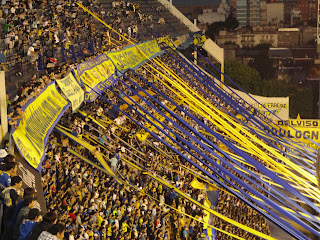
The opposition and the result (a draw) were however irrelevant. The entertainment here was the home crowd who, literally, made a spectacle of themselves. For the whole 90 minutes they maintained an anstonishing level of noise, singing rather tunefully along to the drum beat and all the time jumping up and down and waving their arms in unison. There was ticker tape, blue and yellow flares and various antics that would have a UK health and safety inspector closing the place down. As the game wore on the decibel level rose and they were not even silenced by the late equaliser their team conceded. A shame because if the fans had the team they deserved, they would be world champions. A world away from the polite applause that greets a goal at Arsenal.

Having enjoyed the show, the next morning we walked back down to La Boca to see El Caminito and find a traditional Italian eating place (the community and football club were founded by poor Italian immigrants).

Bizarrely, after opening the door to what seemed a humble Italian restaurant in a back street near La Bombonera (the chocolate box) stadium, we found ourselves not in the company of tourists or impoverished locals, but tables of men in suits. Since most looked like current or former footballers and yesterday was the last day of the season, we concluded that the constant ringing of mobile phones was down to ongoing negotiations of contracts and transfers.
Despite pretty much everyone else being smart and us being dressed shambolically to avoid being mugged, we decided to tough it out and sat down for a rather enjoyable lunch featuring some of the best home made pasta that we have ever had. After ordering some reasonably expensive wine the waiter started to take us seriously and we crossed our fingers that this would not be the day that the bank decides to block the credit card after a series of transactions in South America.
Here bus loads of tourists arrive to photograph El Caminito and to have their photo taken with locals dressed as tango dancers before being whisked back out of danger.
It is a bit of a theme park but worth the walk from San Telmo to see. We came on monday evening for the other local attraction - to see the world famous local football team, Boca Juniors, play an Argentinian league match against the wonderfully named Gymnastic and Fencing Club from the nearby city of La Plata.

The opposition and the result (a draw) were however irrelevant. The entertainment here was the home crowd who, literally, made a spectacle of themselves. For the whole 90 minutes they maintained an anstonishing level of noise, singing rather tunefully along to the drum beat and all the time jumping up and down and waving their arms in unison. There was ticker tape, blue and yellow flares and various antics that would have a UK health and safety inspector closing the place down. As the game wore on the decibel level rose and they were not even silenced by the late equaliser their team conceded. A shame because if the fans had the team they deserved, they would be world champions. A world away from the polite applause that greets a goal at Arsenal.

Having enjoyed the show, the next morning we walked back down to La Boca to see El Caminito and find a traditional Italian eating place (the community and football club were founded by poor Italian immigrants).

Bizarrely, after opening the door to what seemed a humble Italian restaurant in a back street near La Bombonera (the chocolate box) stadium, we found ourselves not in the company of tourists or impoverished locals, but tables of men in suits. Since most looked like current or former footballers and yesterday was the last day of the season, we concluded that the constant ringing of mobile phones was down to ongoing negotiations of contracts and transfers.
Despite pretty much everyone else being smart and us being dressed shambolically to avoid being mugged, we decided to tough it out and sat down for a rather enjoyable lunch featuring some of the best home made pasta that we have ever had. After ordering some reasonably expensive wine the waiter started to take us seriously and we crossed our fingers that this would not be the day that the bank decides to block the credit card after a series of transactions in South America.
12 Dec 2010
San Telmo - In the Here and Now
We are staying in a boutique hotel in an area of Buenos Aires known as San Telmo, which is just to the south of the centre of the city. Su chose it as it sounded a little different from the rest of the city - lots of old buildings and known for its antique shops and tango bars.
San Telmo has an interesting history. It was the home of the rich when Argentina was one of the richest countries in the world in the second half of the 19th century, but when yellow fever began to spread from the poverty of nearby Boca the rich suddenly left, abandoning their mansions never to return.
The mansions were then used by groups of poorer families and, as Argentina went into steady financial decline, there was never the money to restore them. More recently however, drawn by the bohemian reputation of the area, restoration has begun. On sundays the entire area goes into fiesta mode as the main square becomes the antique market and the surrounding streets become spontaneous open air concert venues. Small groups of musicians play samba, tango, Spanish guitar music and many other varieties and as evening draws on the market stalls are removed and the locals (plus some suitably trained tourists) start to dance the tango.

San Telmo is now a real draw for tourists and locals and the renovation is gathering pace such that the area can forget its sad past and look forward to a brighter future. As it celebrates the bicentenary of its independence this year, Argentina more generally will be looking forward to greater prosperity and stability than it experienced over the course of the last century.
However on a sunny sunday afternoon watching the tango and dancing to the samba band it is not time to dwell on the past or think of the future, for San Telmo lives in the here and now. In that spirit we too are simply savouring the moment.
10 Dec 2010
Water, Water Everywhere
We flew from Rio on an internal Brazilian flight to Foz de Iguaçu, close to the border with Paraguay and Argentina. The objective of the visit was to see Iguazu Falls, one of the natural wonders of the world. The Falls are the widest set of waterfalls in the world and has one of the longest drops. Í haven't been to Niagara but apparenty Iguazu makes it look like a leaking roof.
Our hotel was on the Argentinian side but having landed on the Brazilian side on a beautiful day we took a spur of the moment decision to visit the Brazilian national park that afternoon - a great decision because at the same time the next day there was a massive downpour. The panoramic views get better and better as you go around and it is possible to get very close to one of the biggest falls on a precarious loking walkway, although you get pretty wet in the process. It was a truly memorable afternoon.

We joined the same tour group again this morning and visited the Argentinian side. Predictably the rivalry over who has the best national park is a bit like that between the national football teams. We called it a draw - Argentina has 80% of the falls area but Brazil has the best views. The things that Argentina does best is the walkways which take you right out under and over the main falls and the boat ride which we did in the afternoon.

The ride is called "the Great Adventure" and we went out on a motor launch with around 30 other people towards the face of the two main falls. They give you an opportunity to take photos from the boat really close to the water before they warn you to put your cameras away before they go closer. And they get really close. We had been warned that we would get wet and from our place near the back it was clear that those at the front would get really soaked as the launch approached the wall of falling water. However just to make sure that we all benefitted from the experience the captain kindly turned the boat around and reversed into the waterfall. It was a great experience and absolutely hilarious being in the spray of a huge waterfall only a few feet from where the water was falling - trying to admire this majestic sight from close up while water comes at you as if out of a fire hose.
It is a long way to go to get here but really worth it. It has also been nice to get over the border and be able to hold a conversation with the locals, for now we are in Spanish-speaking Argentina, home of the gauchos, the best beef in the world, tango and of course the legendary Diego Maradona.
Subscribe to:
Posts (Atom)