Here is a slideshow of around sixty photos of our recent trip to South America covering everything except Galapagos. Included here are some shots from Lima (not the prettiest city in the world), Cusco, the Inca Trail and Machu Picchu (which was everything it is cracked up to be), the trip to Lake Titicaca and across into Bolivia, La Paz and Quito. In summary, lots of Inca remains, mountain and lake scenery and colonial and modern city shots, which we hope you enjoy. A great trip all round!
Showing posts with label peru. Show all posts
Showing posts with label peru. Show all posts
4 Jun 2011


29 Apr 2011
Lake Titicaca
The lake is still sacred to the Aymara and Quechua Indians that inhabit it's shores because the existence of a body of water 100 miles long and 60 wide absorbs enough of the sun's heat to create a micro-climate warm and humid enough to grow a few crops even at 3810m above sea level. It also provides a supply of fish and of course water.
When the Spanish brought Catholicism they replaced the Sun with Jesus and Mother Earth with a Virgin Mary the colour of local women. They built the most important church in Bolivia at Copacabana on the lake shore near Island of the Sun, the Mecca of the Andean religion. We saw today a local shaman perform a traditional ritual which ended with us receiving a rather catholic blessing - the two religions are interwoven here as the easiest way to force people to convert to a religion they didn't understand was to make it look like the one they already had. Killing people who wouldn't convert was also persuasive.
Here on the lake we have seen two communities who continue to live in peace in their traditional manner despite everything. On the island of Taquile around 4000 people live without roads or vehicles with only a seasonal supply of rain water and some solar panels for energy. Traditional dress dating back to the early colonial period is compulsory. The men wear red and white woolly hats if they are single, red and blue if they are married, while married women wear dark skirts and singles wear bright colours. The men are always knitting and make their own hats while the women do the weaving. Outsiders can't buy property and anyone marrying into the community has to follow its strict rules. The only jobs are farming and fishing but these days they supplement their income by selling some of the wool and woven goods that they produce. Taquile is remarkably tranquil and has beautiful views of the Lake.
 |
| On Taquile |
 |
| Women of Uros floating islands |
As we cross the sacred lake by catamaran from Peru to Bolivia from Peru, it continues to provide for the various communities who live here at nearly 4000m above sea level. Despite the hardships of life and the history of violent repression, the indigenous people are starting to reassert themselves and find a place in the modern world which enables them to maintain their way of life. The Incas may have gone but their descendants maintain their memory, identity and values.
28 Apr 2011
Where Next for Peru?
Today is our last day in Peru after nearly two weeks. We really like the country as there is lots to see and do and the people are friendly. However many Peruvians seem worried about the future after the results of the first round of the Peruvian presidential elections were announced shortly before we arrived in the country. The original five candidates have been whittled down to the final two for the run-off in June. These are Keiko Fujimori, 36 year old daughter of former president Alberto Fujimori (born in Peru of Japanese parents) and the former army lieutenant colonel Ollanta Humala.
There seems general concern among people we have spoken to about the risks to the country presented by both candidates and no one seems to want either to win. Some commentators fear for the future of democracy here itself but one of Keiko and Ollanta has to win. Everywhere, in true Latin American style, one sees the names of the candidates painted on walls in bright colours.
Peru has made substantial economic progress in recent years but some, especially the rural poor, have been left behind as seems typical in this continent where inequality seems greater than anywhere else. Consequently Ollanta's (probably undeliverable) promises to the poor attracted 31% of the first round vote. However his changing political stance, his closeness to the anti-US Venezuelan president Hugo Chavez and his military past (he was part of an attempted coup a few years ago) worry many that Peru might follow it's neighbour Bolivia in the wrong direction.
On the other hand Keiko (22% in the first round) is closely associated with her father Alberto, who is currently serving a 25 year jail sentence for corruption. Despite her relative youth she has a track record too. When her father sacked her mother as First Lady in 1994 for accusing him publicly of corruption, the then 21 year old Keiko became First Lady and for six years was therefore implicated in his regime, which as well as corruption included the closing of Congress which effectively made her father a dictator.
Many suspect that Keiko's father is pulling the strings now from prison and that he will be released if she wins. While born in Peru, he fled to Japan after being deposed, apparently saying that he was Japanese rather than Peruvian, which further damaged his popularity. To add spice to the current contest it was against Fujimori that Ollanta was involved in the attempted coup and he was only pardoned when Fujimori was found guilty of corruption.
So we have a soap opera of an election, the result of which no one can predict as nearly half the electorate didn't vote for either candidate in the first round. The only certainty is that a lot of Peruvians and most of the international community are going to get a president they don't want with potentially serious implications for the future of the country.
There seems general concern among people we have spoken to about the risks to the country presented by both candidates and no one seems to want either to win. Some commentators fear for the future of democracy here itself but one of Keiko and Ollanta has to win. Everywhere, in true Latin American style, one sees the names of the candidates painted on walls in bright colours.
Peru has made substantial economic progress in recent years but some, especially the rural poor, have been left behind as seems typical in this continent where inequality seems greater than anywhere else. Consequently Ollanta's (probably undeliverable) promises to the poor attracted 31% of the first round vote. However his changing political stance, his closeness to the anti-US Venezuelan president Hugo Chavez and his military past (he was part of an attempted coup a few years ago) worry many that Peru might follow it's neighbour Bolivia in the wrong direction.
On the other hand Keiko (22% in the first round) is closely associated with her father Alberto, who is currently serving a 25 year jail sentence for corruption. Despite her relative youth she has a track record too. When her father sacked her mother as First Lady in 1994 for accusing him publicly of corruption, the then 21 year old Keiko became First Lady and for six years was therefore implicated in his regime, which as well as corruption included the closing of Congress which effectively made her father a dictator.
Many suspect that Keiko's father is pulling the strings now from prison and that he will be released if she wins. While born in Peru, he fled to Japan after being deposed, apparently saying that he was Japanese rather than Peruvian, which further damaged his popularity. To add spice to the current contest it was against Fujimori that Ollanta was involved in the attempted coup and he was only pardoned when Fujimori was found guilty of corruption.
So we have a soap opera of an election, the result of which no one can predict as nearly half the electorate didn't vote for either candidate in the first round. The only certainty is that a lot of Peruvians and most of the international community are going to get a president they don't want with potentially serious implications for the future of the country.
27 Apr 2011
Slow Train to Puno
After spending a night in Cusco we caught the Andean Explorer train to Puno, on the shores of Lake Titicaca. This is a first class service with wood-paneled carriages which takes ten (yes, ten) hours to cover just 300 miles. There is an open viewing platform and bar in the last carriage with various forms of entertainment to pass the time.
The scenery starts with the urban sprawl of the outskirts of Cusco where dogs chase up and down the side of the train. Apparently they are all owned by families but the Peruvians don't feed them so they have to go out to forage for food among the garbage.
Before long we were into rural areas where the steep sided valleys are filled with cornfields and villages with mud brick houses. Friendly looking people wave at the train including a guy standing knee deep in a river brandishing a large fish he had just caught as if it was the FA Cup. Every now and again a larger more prosperous looking town appears. My assessment of relative wealth is based mainly on the quality of football facilities which range from old goalposts on wasteland to smart little municipal stadia complete with grass pitch, cinder track and seating for a couple of hundred people.
As the journey wears on the track climbs to its highest point at 4320m where we stopped for the first time among snow covered mountains. It is too high for growing corn so the locals keep alpaca and llama, cows, sheep, pigs and donkeys and of course sell woolen garments to train travellers who get off for ten minutes. It is clear that people do actually wear this stuff in their daily lives in rural Peru - not just to have photos taken with tourists - but we suspect that when people get home with their jumpers, ponchos and hats with woven pictures of llamas all over them, they won't be wearing them to the pub.
Beyond the mountains the train descends onto the high plain where the scenery becomes rather featureless. The second stop at Juliaca could not have been more of a contrast to the first. The guide book describes it as like a large, down-at-heel, desert bound work-camp. I wouldn't disagree. You can buy just about anything at the street market which the train passes through at walking pace. Fruit, vegetables and books lie between the rails so that when the train comes the traders and customers stand back for a minute or two before resuming. The town has a Wild West feel and we weren't encouraged to get out this time.
The most curious sight was earlier on when two grey haired european looking blokes with cameras appeared just as I was trying to take a picture of a local village scene. Bizarrely a little later the same two appeared again. All told we saw them four times, standing next to their red 4x4 vehicle taking photos of our train. The car presumably goes quite a bit faster than the train, enabling determined trainspotters to get lots of shots in different backgrounds. We have seen many exotic new things on this trip but trainspotting is unmistakably British.
 |
| I´ve always loved trains! |
Before long we were into rural areas where the steep sided valleys are filled with cornfields and villages with mud brick houses. Friendly looking people wave at the train including a guy standing knee deep in a river brandishing a large fish he had just caught as if it was the FA Cup. Every now and again a larger more prosperous looking town appears. My assessment of relative wealth is based mainly on the quality of football facilities which range from old goalposts on wasteland to smart little municipal stadia complete with grass pitch, cinder track and seating for a couple of hundred people.
As the journey wears on the track climbs to its highest point at 4320m where we stopped for the first time among snow covered mountains. It is too high for growing corn so the locals keep alpaca and llama, cows, sheep, pigs and donkeys and of course sell woolen garments to train travellers who get off for ten minutes. It is clear that people do actually wear this stuff in their daily lives in rural Peru - not just to have photos taken with tourists - but we suspect that when people get home with their jumpers, ponchos and hats with woven pictures of llamas all over them, they won't be wearing them to the pub.
 |
| Su meets the locals... |
The most curious sight was earlier on when two grey haired european looking blokes with cameras appeared just as I was trying to take a picture of a local village scene. Bizarrely a little later the same two appeared again. All told we saw them four times, standing next to their red 4x4 vehicle taking photos of our train. The car presumably goes quite a bit faster than the train, enabling determined trainspotters to get lots of shots in different backgrounds. We have seen many exotic new things on this trip but trainspotting is unmistakably British.
26 Apr 2011
Machu Picchu
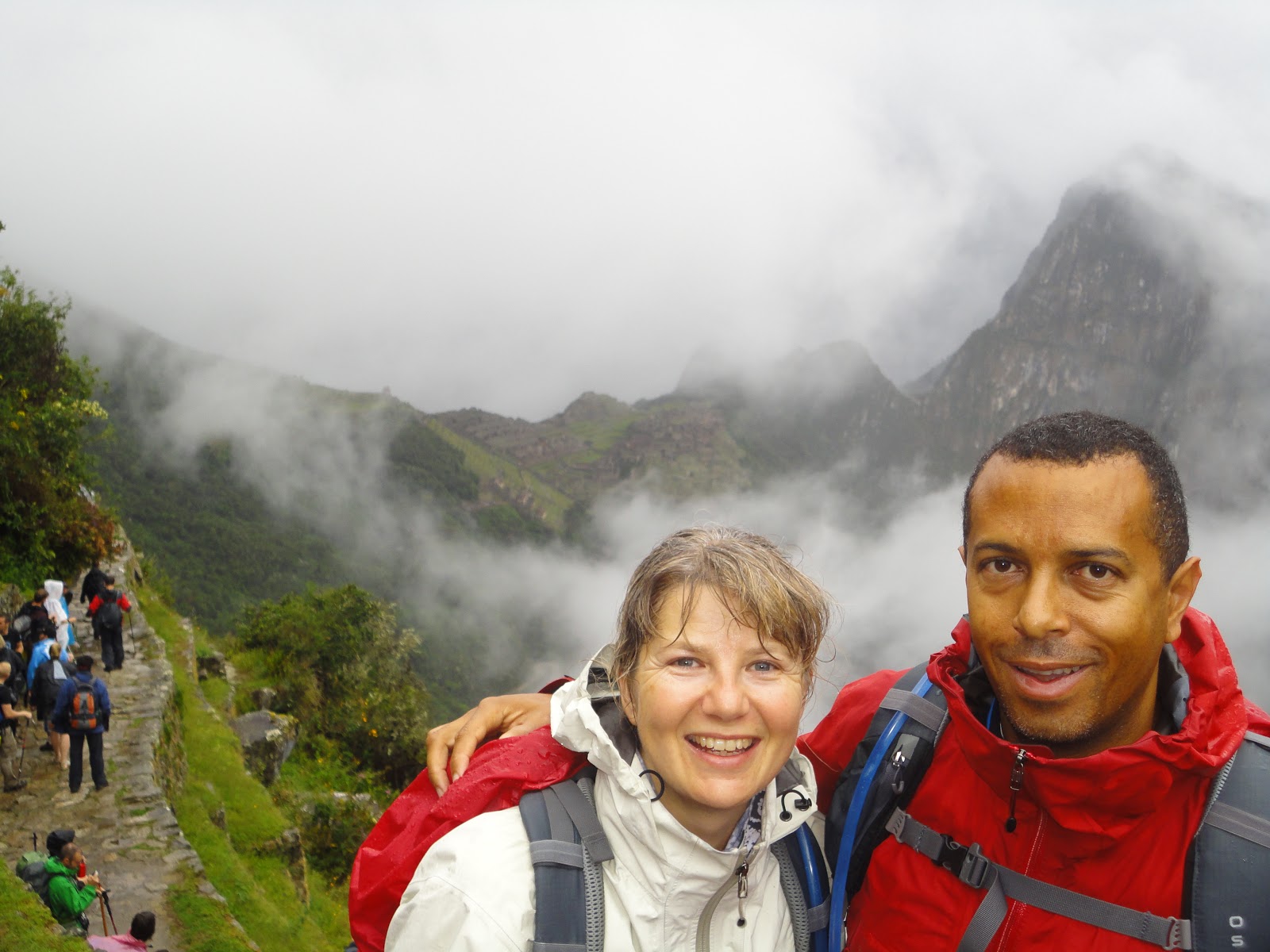
After three good days weather, some glorious views and fascinating Inca site visits our luck ran out during our last night under canvass. We got up for breakfast just before 4am and left the campsite at daybreak in our waterproofs. Towards the end of the last 6km of the Inca Trail the rain eased briefly and we emerged over the hill through the Sun Gate.
In the distance through a break in the cloud we looked down on the citadel for the first time. But within minutes, like Brigadoon, it had vanished into the mist to the disappointment of those who had come so far on foot. Some were still less fortunate, arriving after the window in the weather and missing the view completely. With tired legs the bedraggled platoon of pilgrims plodded slowly downhill in increasingly heavy rain until finally we were close enough to see the citadel close up. Wow!
We had dreamed of seeing the sunrise here but it was not to be and the walkers mostly melted away. Undeterred, Miguel began our tour as the rain pelted still harder. For more than an hour we explored the citadel, almost alone, even our companions having bailed out. We had got the unlikely outcome of seeing the main sites without the crowds but the surrounding scenery was lost in the cloud.
The citadel sits on a high steep sided promontory surrounded on three sides by a horseshoe bend in the Urubamba River, on a saddle-like piece of land between Wayna Picchu (young mountain) and the higher Apu Machu Picchu (old mountain). All around on the other side of the river are a ring of further mountains which creates a spectacular location suitable for a genuine wonder of the modern world. The citadel is hidden from view in every direction - no wonder the Spanish conquistadors never found it.
There are houses where the nobility lived, temples, many terraces for agricultural purposes and a host of other buildings all perfectly preserved after half a century except for the missing straw roofs. Every now and again one turns a corner and sees some remarkable detail of stonework and carvings - condors, puma, snakes and llamas - the sacred animals of the Incas. It is so captivating we stayed four hours in the rain trying to take it in before we descended the hill to find our hotel.
Disappointed only by the lack of views we decided we were too tired to go back the next morning. But when dawn broke and the sun was out we could not resist and took the chance to climb the mountain again. Sometimes there is a second chance to make a first impression and, bathed in sunshine, Machu Picchu did just that. We just sat and relaxed, drinking it in and then wandered round, all the time noticing more and more. Two days, two incredibly different moods.
The Incas didn't write nor produce pictorial evidence of their culture like the Ancient Egyptians. They managed to destroy enough of the trail from Cusco to conceal the citadel from the Spanish and so no one knows the true story or even it's name. Maybe it was the last stronghold of the last Inca king. Maybe it was ultimately abandoned because of disease. There are lots of theories of what happened before a ten year old boy took American Hiram Bingham there 100 years ago this year to find three families living in the overgrown citadel. That no one knows the true story just adds to the mystique of a place that might just be the most magical on Earth.
In the distance through a break in the cloud we looked down on the citadel for the first time. But within minutes, like Brigadoon, it had vanished into the mist to the disappointment of those who had come so far on foot. Some were still less fortunate, arriving after the window in the weather and missing the view completely. With tired legs the bedraggled platoon of pilgrims plodded slowly downhill in increasingly heavy rain until finally we were close enough to see the citadel close up. Wow!
 |
The citadel sits on a high steep sided promontory surrounded on three sides by a horseshoe bend in the Urubamba River, on a saddle-like piece of land between Wayna Picchu (young mountain) and the higher Apu Machu Picchu (old mountain). All around on the other side of the river are a ring of further mountains which creates a spectacular location suitable for a genuine wonder of the modern world. The citadel is hidden from view in every direction - no wonder the Spanish conquistadors never found it.
There are houses where the nobility lived, temples, many terraces for agricultural purposes and a host of other buildings all perfectly preserved after half a century except for the missing straw roofs. Every now and again one turns a corner and sees some remarkable detail of stonework and carvings - condors, puma, snakes and llamas - the sacred animals of the Incas. It is so captivating we stayed four hours in the rain trying to take it in before we descended the hill to find our hotel.
Disappointed only by the lack of views we decided we were too tired to go back the next morning. But when dawn broke and the sun was out we could not resist and took the chance to climb the mountain again. Sometimes there is a second chance to make a first impression and, bathed in sunshine, Machu Picchu did just that. We just sat and relaxed, drinking it in and then wandered round, all the time noticing more and more. Two days, two incredibly different moods.
 |
25 Apr 2011
The Inca Trail
We like walking and we have always wanted to go to Peru so we thought why not do the Inca Trail, the 26 mile trek spread over four days an ending at Machu Picchu? Why not? Simple. It involves camping and we don't do tents. I haven't slept in a tent since my brief spell in the army cadets at school when the camp-site was wiped out by a thunderstorm. Even wedding receptions in marquees worry me. So why I agreed to do this I don't know. I can't have been under pressure from Su who is too partial to comfortable hotels to want to sleep in a field.
But here we are and it has been great. Our group of up to 12 people turned out to be just us and an Australian couple in their sixties, Keven and Mary (originally from England so we didn't spend three days harping on about the Ashes) with our guide, Miguel.
The main challenge is not the distance or even the mountainous terrain but the altitude. We've seen people breathing with oxygen tanks just sitting in a hotel in Cusco, so climbing up to Dead Woman's pass on Day 2 to 4,200m is a serious matter.
The mountain scenery is spectacular and dotted with a variety of religious, defensive, urban and agricultural Inca sites which break up the walking. The scenery changes from river valleys with farming to snow covered mountain ranges and sub-tropical cloud forest before the jungle gets thicker towards the end. The trail is mostly built with huge stones - sometimes flat and at other times like a staircase. As a feat of engineering it is remarkable. The Incas could teach Islington Council a few things about road surfaces although amazingly, given their advanced technology they never invented the wheel.
Being in a small group has enabled us to move faster, escape the crowds to a large degree and experience most of this remote scenery with very few people around. The 200 or so tourists per day come together in the evening at the beautifully located camp sites and have dinner in their groups.
Our support team of eight locals has food ready and the tents up before we arrive. They also bring us water and carry the gear we don't need during the day. The porters are shy, humble indigenous people from the surrounding villages who quietly go about their business. In between their tasks they look at the tourists with an air of bemusement - what they make of us lot I really don't know.
In some ways the Trail is very egalitarian. Backpackers and up-market travellers have to walk the same route, take their chances with the weather and rough it a bit in the camp sites where the toilets are not the best. But a huge divide remains between the porters and the guests whose worlds are so far apart. These culture clashes are a part of international tourism and inevitably leave one with some misgivings. Hopefully tourism will ultimately enrich the lives of these local people as much as it has enriched ours.
On arrival at Machu Picchu this morning we felt a sense of achievement on reaching one of the modern wonders of the world the hard way on foot. As for the camping it wasn't too bad as the weather was kind to us but it may be a while before we are next under canvass.
But here we are and it has been great. Our group of up to 12 people turned out to be just us and an Australian couple in their sixties, Keven and Mary (originally from England so we didn't spend three days harping on about the Ashes) with our guide, Miguel.
 |
The mountain scenery is spectacular and dotted with a variety of religious, defensive, urban and agricultural Inca sites which break up the walking. The scenery changes from river valleys with farming to snow covered mountain ranges and sub-tropical cloud forest before the jungle gets thicker towards the end. The trail is mostly built with huge stones - sometimes flat and at other times like a staircase. As a feat of engineering it is remarkable. The Incas could teach Islington Council a few things about road surfaces although amazingly, given their advanced technology they never invented the wheel.
Being in a small group has enabled us to move faster, escape the crowds to a large degree and experience most of this remote scenery with very few people around. The 200 or so tourists per day come together in the evening at the beautifully located camp sites and have dinner in their groups.
Our support team of eight locals has food ready and the tents up before we arrive. They also bring us water and carry the gear we don't need during the day. The porters are shy, humble indigenous people from the surrounding villages who quietly go about their business. In between their tasks they look at the tourists with an air of bemusement - what they make of us lot I really don't know.
 |
On arrival at Machu Picchu this morning we felt a sense of achievement on reaching one of the modern wonders of the world the hard way on foot. As for the camping it wasn't too bad as the weather was kind to us but it may be a while before we are next under canvass.
22 Apr 2011
Into the Valley
Moving on from Cusco towards the Sacred Valley of the Incas where the Inca Trail begins we travelled through Chinchero, Moray and Maras on our way to our overnight stop at Ollantytambo, the last town in the valley before Machu Picchu and where you get the train if you want to visit it the easy way.
Today has been a fascinating insight into traditional life in rural Peru whose level of wealth does not seem far removed from the equivalent village in Cameroon. Villagers walk their animals along the narrow roads and grow potatoes on the steep Inca terraces built into the side of 5000m high snow covered mountains.
We saw traditional weaving and dyeing of alpaca wool using natural ingredients such as the cochineal beetle and visited a salt mine where whole families continue to scrape a living. Our guide said she had met a woman of over 80 who had been extracting salt from the ponds on the hillside for well over half a century. The families need the children to work there too and large families persist because more workers are needed.
Others have of course switched focus to the tourist market and who can blame them, as traditional life looks tough and increasingly economically unviable. They find their way to the city and an uncertain future where some women make a living by posing for photos in traditional dress with llamas of all ages. The baby lambs are sweet and make the best returns. The street sellers are persistent and start young too. We've met the same 7 year old a couple of times in the town square in Cusco. Being 7 years old his sales technique is abrupt but endearing. "Buy my doll" he instructs you in English, followed by "I take credit card"! When you say no, like any child he demands "why?".
So the choice is the between the harsh reality of traditional rural family life and the potentially harsher reality of a city which at least offers a small chance of making your fortune.
 |
 |
 |
So the choice is the between the harsh reality of traditional rural family life and the potentially harsher reality of a city which at least offers a small chance of making your fortune.
21 Apr 2011
Cusco, Home of the Incas
Inca legend has it that around 1200 AD Manco Capac, the first Inca leader, left Lake Titicaca in search of the location for the temple to the sun god. This turned out to be Qosqo (now Cusco meaning belly button) which went on to become the centre of an empire that extended along the Andes north past modern day Quito in Ecuador and well beyond Santiago de Chile in the south. On a European scale this would stretch from Lisbon to Moscow, some 2500 miles.
Nowadays Cusco is a cosmopolitan city of half a million inhabitants but its old city centre is full of Inca remains. Spanish colonial buildings sit on top of Inca walls built with huge rocks that were chiseled to fit exactly together. It is a lovely place to spend a few days and is a worthy destination in itself - not just a stopping off point for Machu Picchu.
While here we have visited the Inca Museum to see some of the treasures that have been unearthed and been to some outlying sites such as Sacsaywayman on the hill above the city. There we had a demonstration of why the Incas respected nature as a sunny afternoon turned into a vicious hail storm complete with a lightning strike and a rainbow.
The Inca dominance spread until around 1530 when Pizarro's small expeditionary force arrived from Spain. With the limited resources of just 180 men, 27 horses and a cannon, Pizarro and his brutal conquistadors overthrew one of the world's great empires which had an army of 100,000 men. He was aided by a civil war among the Incas, a smallpox epidemic and probably the belief locally that they were gods.
The rest as they say is history. And of course history is written by the winners, so the carnage, large-scale theft and attempted destruction of a culture was justified in the name of the Church. The 1500s was Spain's golden age and the similarities with what we saw on last month's trip to Andalucía are striking. The cloistered patio of our hotel is almost identical to our hotel in Ubeda, which was built to celebrate the reconquest of Spain from the Moors. The Christians also built on top of the main Inca Temple of the Sun, much as they did at the mosque in Córdoba. The Moors who were ultimately expelled from Spain by the Inquisition would be surprised I'm sure if they knew that their arches would reappear in the Christian conquerors' buildings in South America.
However despite everything the indigenous culture has survived where the Moors didn't and tell tale signs of Inca resistance can be found even in the religious paintings in the Cathedral where the odd stray serpent appears. Now a new invasion, this time of tourists, has even started to bring the wealth back.
Nowadays Cusco is a cosmopolitan city of half a million inhabitants but its old city centre is full of Inca remains. Spanish colonial buildings sit on top of Inca walls built with huge rocks that were chiseled to fit exactly together. It is a lovely place to spend a few days and is a worthy destination in itself - not just a stopping off point for Machu Picchu.
While here we have visited the Inca Museum to see some of the treasures that have been unearthed and been to some outlying sites such as Sacsaywayman on the hill above the city. There we had a demonstration of why the Incas respected nature as a sunny afternoon turned into a vicious hail storm complete with a lightning strike and a rainbow.
 |
The rest as they say is history. And of course history is written by the winners, so the carnage, large-scale theft and attempted destruction of a culture was justified in the name of the Church. The 1500s was Spain's golden age and the similarities with what we saw on last month's trip to Andalucía are striking. The cloistered patio of our hotel is almost identical to our hotel in Ubeda, which was built to celebrate the reconquest of Spain from the Moors. The Christians also built on top of the main Inca Temple of the Sun, much as they did at the mosque in Córdoba. The Moors who were ultimately expelled from Spain by the Inquisition would be surprised I'm sure if they knew that their arches would reappear in the Christian conquerors' buildings in South America.
However despite everything the indigenous culture has survived where the Moors didn't and tell tale signs of Inca resistance can be found even in the religious paintings in the Cathedral where the odd stray serpent appears. Now a new invasion, this time of tourists, has even started to bring the wealth back.
19 Apr 2011
Grounded
Getting to Cusco proved more difficult than we expected as our flight with the local airline TACA was cancelled amid extraordinary scenes at Cusco airport. Irate passengers besieged the desk at the gate as they told us Cusco airport was closed due to bad weather. Meanwhile other flights left for the same destination and they even boarded our plane from a gate downstairs in the hope we wouldn't notice.
As the truth became apparent we joined the scrum for the last few places downstairs, which were allocated on a "who shouts loudest" basis. When, like us, a group of middle aged women missed out they formed a human barrier across the gate to prevent the last passengers boarding. They were forcibly removed by security.
TACA got us back to the airport for a second attempt at 245am so that we could wait two more hours to check in. More rows ensued as they made a shambolic attempt to separate yesterday's passengers from the people they were going to let down today. It is clear that the people in the Sheraton, where we spent the night, are very used to looking after stranded TACA passengers.
But we made it to Cusco in the end this morning, less than an hour after the new scheduled arrival time and we still have three days to get used to the thin air here at 3,400 metres (11,000 feet) above sea level before we start the Inca Trail - the four day walk to Machu Picchu.
As the truth became apparent we joined the scrum for the last few places downstairs, which were allocated on a "who shouts loudest" basis. When, like us, a group of middle aged women missed out they formed a human barrier across the gate to prevent the last passengers boarding. They were forcibly removed by security.
TACA got us back to the airport for a second attempt at 245am so that we could wait two more hours to check in. More rows ensued as they made a shambolic attempt to separate yesterday's passengers from the people they were going to let down today. It is clear that the people in the Sheraton, where we spent the night, are very used to looking after stranded TACA passengers.
But we made it to Cusco in the end this morning, less than an hour after the new scheduled arrival time and we still have three days to get used to the thin air here at 3,400 metres (11,000 feet) above sea level before we start the Inca Trail - the four day walk to Machu Picchu.
Subscribe to:
Posts (Atom)